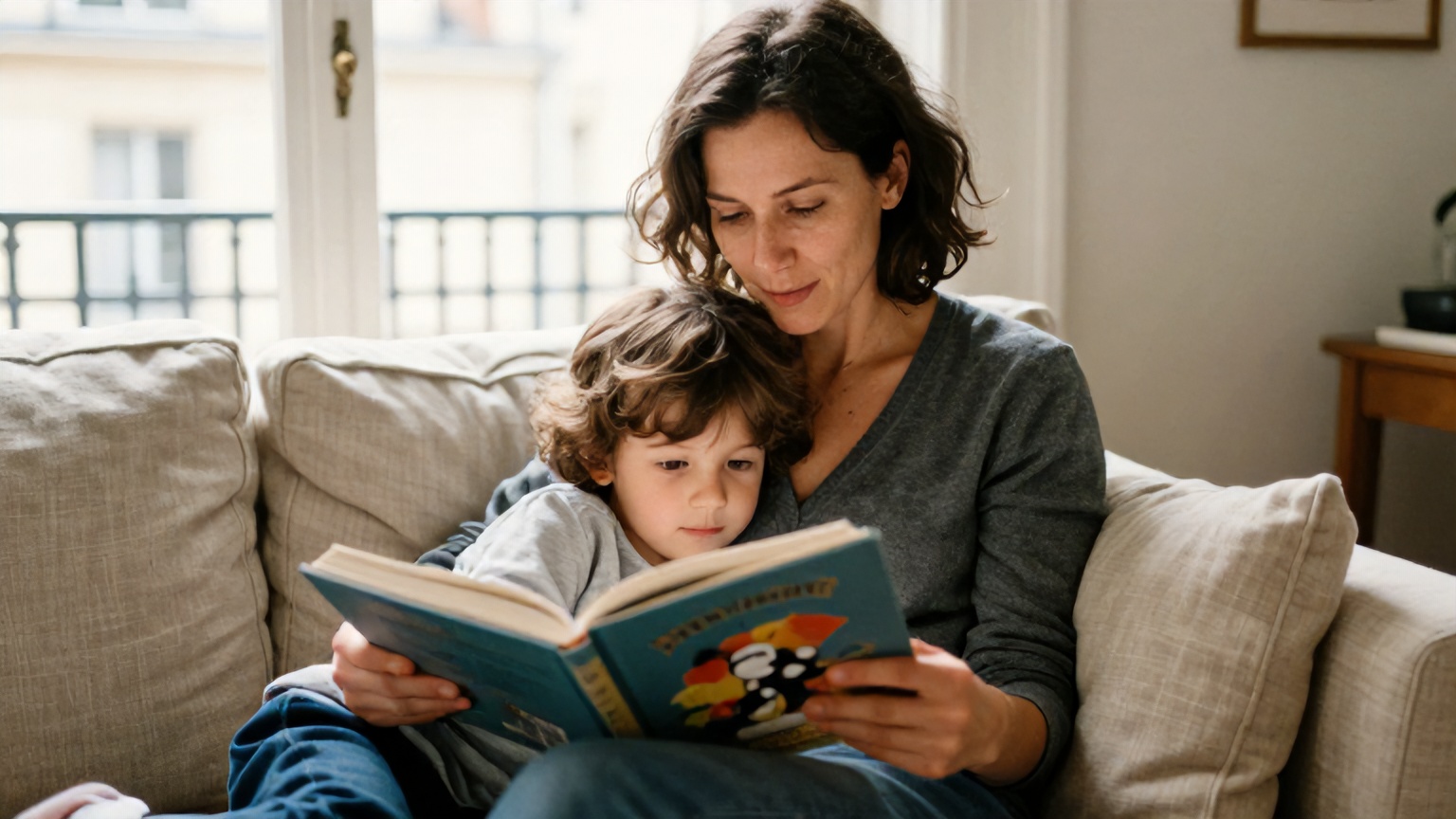
You'd love your kids to read. You know reading develops vocabulary, focus, empathy, and academic success. You've read the articles, heard the experts. But when you hand a book to your 8-year-old, they look at you with all the enthusiasm of someone taking an accounting exam.
You've tried everything: recommended book lists, a cozy reading corner, library visits. Nothing sticks. And sometimes, a doubt creeps in: what if your child simply doesn't like reading?
Take a breath. Almost all children can love reading. But passing it on takes less obvious paths than you'd think — and the first of those paths is you.
The data that changes everything
Studies on reading habits have revealed a striking finding: children whose parents consider reading very important in their household are readers at over 95%. Among them, 41% become avid readers (more than 20 books per year).
In other words, what best predicts whether a child will read isn't the number of books in their room, nor library visits, nor verbal encouragement. It's the place reading occupies in the parents' lives. Children imitate what they see, not what they're told.
And that's where many parents realize a gap: they want their child to read, but they themselves don't read — or no longer read. Not from lack of desire, but from lack of time, habit, or priority. If that's you, the first step isn't pushing your child toward books. It's getting back into reading yourself.
Rule #1: Show, don't tell
A child who sees their parent absorbed in a book, evening after evening, receives a powerful message: reading is an adult activity, a desirable activity, a normal activity. This message is infinitely more effective than "go read in your room."
Concretely, that means reading in front of your children. Not in your bedroom with the door closed while they watch cartoons. In the living room, visible, with a physical book (children can't tell the difference between a parent reading on their phone and a parent scrolling Instagram).
If you already read regularly, you have a head start. If you've lost the habit, it's extra motivation to rebuild it. Creating an evening reading routine benefits the whole family — you read your book while your children read theirs, or while you read them a story.
Rule #2: Never force
Every bookseller and children's reading specialist will tell you the same thing: forcing a child to read is the surest way to put them off.
Reading must remain associated with pleasure, not obligation. If your child refuses a book, accept the refusal. If your child reads only 5 pages before putting the book down, celebrate the 5 pages. If your child wants to reread the same book for the fifteenth time, let them — rereading is a form of literary love.
The command "you must read" creates a negative association. The invitation "shall we read together?" creates a positive one. The nuance is subtle, the effect is immense.
Rule #3: Everything counts
Your child only reads comics? That's reading. Manga? That's reading. Dinosaur encyclopedias? That's reading. Joke books? That's reading.
The most common parenting mistake: creating a hierarchy of formats. "Yes but a real book..." is a phrase that has extinguished the desire to read in millions of children. As we explain in our article manga, comics, audiobooks: does it count?, science makes no distinction between formats — the brain reads, period.
A child who devours manga develops the same narrative skills as a child who reads novels: comprehension, empathy, imagination, visual vocabulary. And a child who reads manga today might be a novel reader tomorrow — if you haven't blocked the path by telling them their reading doesn't count.
Rule #4: Let them choose
A child who's allowed to choose their own books is much more likely to read them than a child with an imposed selection. It's logical: autonomy is a fundamental motivational driver.
Take your children to bookstores or libraries and let them browse. Let them pick what attracts them — even if the choice surprises you. A book about Pokémon? Perfect. A book with more pictures than text? Perfect. A book "below their level"? Perfect. The level will come naturally if the pleasure is there.
Your role isn't to choose for them. It's to offer the environment (an accessible library, regular bookstore visits, books at home) and trust them to navigate it.
Rule #5: Read to them (even when they can read)
The classic parenting mistake: stopping reading stories to your child as soon as they can read alone. "You're big now, read on your own."
Many children disengage at this point. Why? Because reading alone requires cognitive effort that the beginner reader hasn't yet automated. The bedtime story with a parent was effortless pleasure. Independent reading is effort with work. If you remove the pleasure before the skill is solid, the child loses both.
Continue reading stories to your children well after they can read independently. Until 8, 9, 10 years old — and beyond if the ritual is in place. Some families read chapters of Harry Potter together for months. It's a moment of connection, sharing, and a bridge between pleasure-reading and autonomous reading.
Rule #6: Talk about your reads
Children who grow up in families where people talk about books — "I read something incredible yesterday," "this character really annoyed me," "did you know octopuses have three hearts? I read it in a book" — integrate reading as a social, living activity.
Share your own reads at the table. Ask your children what they're reading — not interrogating like at school, but with genuine curiosity. Recommend books to each other. Create a mini family book club where everyone shares their book of the month.
If you use Bukku to track your own reads, show your stats to your kids from time to time. "Look, I read 4 books this month!" It's a powerful model. And teenagers in particular are drawn to apps and data — offering them to track their own reading can be a surprisingly effective trigger.
Rule #7: Accept the phases
A child who devours books at 7 might not open a single one at 12. That's normal. Adolescence reshuffles priorities — friends, social media, video games, identity seeking. Reading may take a back seat for a while.
Don't panic. If the foundations are laid — if the child has known the pleasure of reading, if they associate books with positive moments, if the home is full of books — reading will return. Often in high school, university, or adulthood.
Your role during this phase: maintain the presence of books (don't empty their bookshelf), keep reading yourself (the model stays active), and suggest without imposing. A book given with "I think you might like this" is a seed that sometimes sprouts months later.
What truly matters
Getting your kids to love reading doesn't require sophisticated techniques. It comes down to three simple things: read yourself, make books accessible, and never turn reading into an obligation.
The rest — the right book, the right moment, the spark — will come. And when it does, you'll see your child absorbed in a book, deaf to the world around them, with that little smile you know well. Because it's the same as yours when you read.
Lead by example for your children: track your reads in Bukku, share your favorites, and build a family of readers together.